Evidence tiers
| Ingredient | Best evidence | What it shows |
|---|---|---|
| AREDS2 formula | NIH trial | ~25% lower progression risk in intermediate AMD |
| Lutein + zeaxanthin | AREDS2; screen trial | Macular pigment, visual performance, less eye strain |
| Bilberry | 12-week RCT | Focusing-muscle findings in screen workers |
| Astaxanthin combos | RCT | Eye-function scores vs placebo |
| Vitamin A, zinc | NIH ODS; NIH ODS | Essential for vision; deficiency harms eyes |
Red flags
- Claims to cure or reverse macular degeneration, cataracts or glaucoma.
- “FDA approved” badges: the FDA doesn’t approve supplements (FDA).
- Hidden autoship or “free trial” billing.
- No contact details or refund policy.
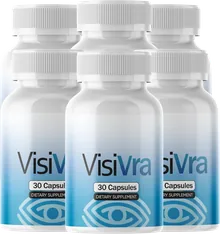
Best Visivra price today: 6 bottles at $49 each (save $780) or 3 bottles at $69 each with free US shipping. One-time payment, no autoship, 60 days to decide.
Check Today’s Discount ›Questions to ask any eye supplement
- Does it contain lutein and zeaxanthin?
- Are the other ingredients backed by human trials?
- Is it one payment with a real guarantee?
- Will it push my vitamin A or zinc over NIH limits (NIH ODS)?
How to tell good research from marketing
Not all “studies” are equal. When a website says a supplement is “clinically proven,” check:
- Was it in people? Lab and animal studies are a starting point, not proof.
- Was there a placebo group? Eye comfort is subjective, so comparison with a dummy pill matters.
- Was it randomized and blinded? That reduces bias.
- How many people, for how long? A few dozen people for 12 weeks or more is far better than a handful for a week.
- What was measured? Objective tests (like focusing-muscle measurements or MPOD) are stronger than questionnaires alone.
- Can you find it? Real studies are listed on PubMed.
The trials we cite throughout this site, such as the 12-week bilberry trial (PubMed) and the 6-month carotenoid trial (PubMed), are placebo-controlled human studies you can read yourself.
Popular eye supplement ingredients with weak or mixed evidence
| Ingredient | Status |
|---|---|
| Bilberry for night vision in healthy people | Rigorous studies didn’t find a benefit (NCCIH) |
| Omega-3 for AMD progression | No benefit in AREDS2 (PubMed) |
| Beta-carotene in eye formulas | Replaced in AREDS2; lung cancer concern in former smokers (NEI) |
| “Proprietary” herbal blends with no named amounts | Usually untested as a combination |
What “working” should mean for you
Set a goal you can actually measure. For a screen worker, “my eyes feel less tired at 6 p.m.” is realistic. For an older adult, “I’m giving my macula the nutrients in the AREDS2 carotenoid pair” is realistic. “I won’t need glasses” isn’t, because refractive errors are optical (NEI). Track your goal weekly for 8–12 weeks.
Safety basics for any eye supplement
- Tell your doctor and pharmacist what you take, especially with prescription medicines (NCCIH).
- Keep total vitamin A and zinc within NIH upper limits (NIH ODS; NIH ODS).
- Ask first if you are pregnant, nursing or smoke.
- Report any serious reaction to the FDA through MedWatch (FDA).
See lutein side effects and astaxanthin side effects for ingredient-specific safety.
Reader questions
Are expensive eye supplements better?
Not necessarily. Look at the ingredients, the evidence and the seller’s terms rather than the price.
Can I trust “doctor formulated” labels?
It is a marketing phrase, not a quality standard. Check ingredients and research yourself.
Is it better to take eye vitamins in the morning?
Take them with a meal containing fat, whatever time suits you (timing tips).
Do eye supplements expire?
Yes. Use them before the best-before date and store them away from heat and light, since carotenoids degrade.
Should I tell my eye doctor?
Always. Bring the label to your exam so your doctor can see exactly what you take.
Our shortlist of evidence-backed choices
If you want the short version: for diagnosed intermediate AMD, an AREDS2 formula chosen with your eye doctor. For everyday macular support, a daily lutein and zeaxanthin source. For screen-heavy days, a formula that adds bilberry and astaxanthin to the carotenoids. For low-light vision, make sure vitamin A and zinc intake is adequate. Visivra combines the last three in one capsule, which is why we cover it on this site.
How to run your own fair test
You can’t run a placebo-controlled trial at home, but you can make your own judgment more reliable. Choose one clear goal, such as end-of-day eye comfort. Record a baseline score for a week before you start. Change only one thing at a time, so you know what made the difference. Take the supplement every day with food for at least 8–12 weeks. Score the same goal once a week. Then compare your average score in the first two weeks with the last two weeks. If you see a clear trend, you have useful evidence for yourself. If not, stop and, if available, use the money-back guarantee.
One more reader question
Should I take an eye supplement in my 30s?
If you spend long hours on screens or eat few greens, it can make sense. Food comes first.
Where Visivra lands
Visivra combines lutein, zeaxanthin, bilberry and astaxanthin with zinc and vitamin A, is a one-time purchase and has a 60-day money-back guarantee. Its order page doesn’t list mg amounts, so check the label. Compare: Visivra vs PreserVision, best eye vitamins for computer users. See Visivra.
FAQ
Do eye supplements really work?
Some do for specific goals: AREDS2 for intermediate AMD, and lutein/zeaxanthin for macular pigment and screen-time comfort.
Which eye supplement has the most research?
The AREDS2 formula for AMD, and lutein + zeaxanthin in general.
Can eye supplements restore vision?
No. They support eye health; they don’t restore lost vision.
Sources
- National Eye Institute (NIH): AREDS/AREDS2 clinical trials
- PubMed: Lutein + zeaxanthin and omega-3 fatty acids for AMD, the AREDS2 randomized trial (JAMA, 2013)
- PubMed: Macular carotenoid supplementation improves visual performance, sleep quality and physical symptoms in people with high screen time (Foods, 2017)
- PubMed: 12 weeks of bilberry extract and ciliary-muscle findings in visual display terminal workers (Nutrients, 2020)
- PubMed: Anthocyanin, astaxanthin and lutein on eye functions, a randomized placebo-controlled study (J Clin Biochem Nutr, 2021)
- NIH Office of Dietary Supplements: Vitamin A and carotenoids
- NIH Office of Dietary Supplements: Zinc
- FDA: Dietary supplements
- NIH Office of Dietary Supplements: Dietary supplements, what you need to know
- NCCIH (NIH): Bilberry
- National Eye Institute (NIH): Refractive errors
- NCCIH (NIH): Using dietary supplements wisely
- FDA: MedWatch safety reporting
General information, not medical advice. Prices and product details come from the official Visivra order page and bottle, checked November 6, 2026; the checkout page and the label on your bottle take priority. Read our disclaimer.